
Water & Energy
On this page: Energy Efficiency Programs | Featured Energy Resources
It takes great amounts of water and energy to produce the crops that California exports around the country and the world. Eight (8) million agricultural acres in California consume 80% of the total water pumped in the state (US Energy Information Administration). Agriculture in California also consumes nearly 8% of the state’s energy, and approximately 70% of this is for water pumping (CA Department of Food & Agriculture).
In times of energy or water shortage, this can place a heavy strain on growers, especially in California’s Southern and Western Central Valley. Resources are available to help growers save money and resources by managing water and energy use simultaneously.
For most agricultural energy users, the majority of energy use is for water pumping and irrigation, especially during the summer growing season. Many farmers rely on groundwater, which is one of the most energy-intensive sources of water available, using between 170 and 600 kilowatt hours (kWh) per Acre-Foot (AF) of water on average. For example, in the Tulare Lake region, the estimate is 431 kWh/AF (California Public Utilities Commission) of groundwater.
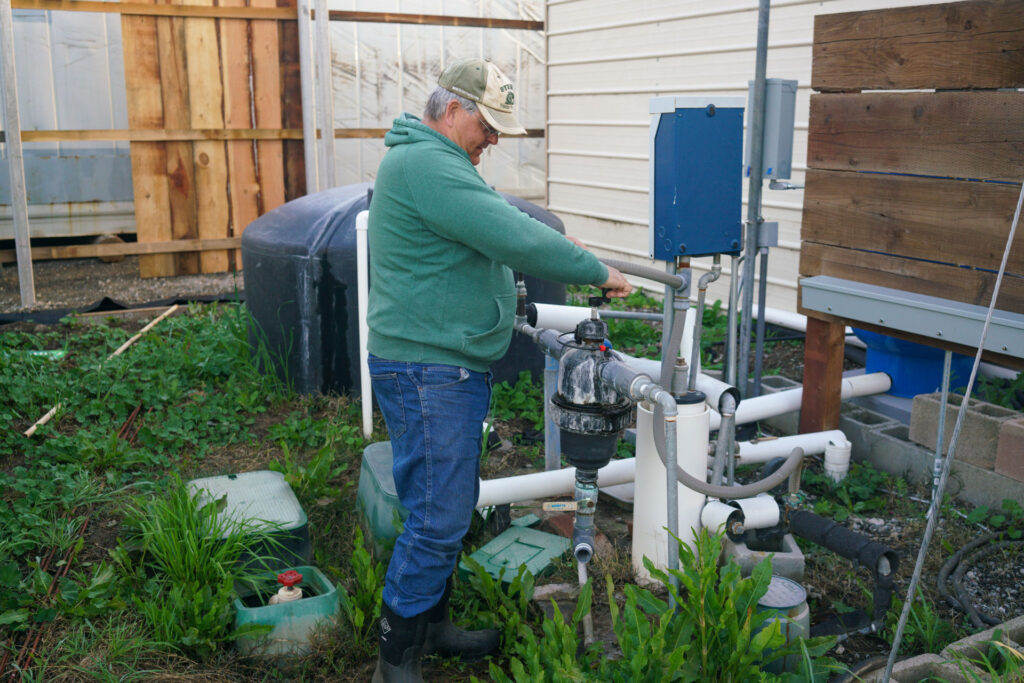
Photo by Lan Ngo
When energy is expensive and water is scarce,
efficiency becomes a matter of survival.
During dry or drought years, the water supply mix ratio shifts from surface to groundwater, resulting in an increase of on-farm energy use due to increased groundwater pumping. Therefore, solutions aimed at increasing the efficiency of groundwater pumps, and increasing the efficiency of water use overall, can make a huge difference in the amount of energy used overall.
In addition, it is critical to improve the integrated management of surface and groundwater resources to ensure that groundwater is recharged in wet years and is not withdrawn below a sustainable or “safe” yield (this practice is known as “conjunctive management”).
Farmers can be quite impacted by the cost of energy. Thirty-three percent of on-farm water usage coincides with peak energy and peak energy pricing, which means that many agricultural water users are paying high prices when they pump water during those peak periods.
Key predictions about California agriculture and water, made almost two decades ago are being realized today, manifesting as the challenges that now face California’s farmers:
- Increasing reliance on groundwater for irrigation
- More energy and water saving pumping and irrigation equipment will replace existing technologies
- The level of groundwater in the aquifer will drop, and its quality will degrade
- In extreme scenarios, agriculture may cease in locations depending heavily on groundwater
Energy Efficiency Programs
California’s Investor Owned Utilities (IOUs) implement energy efficiency programs funded by the Public Goods Charge (PGC), overseen by the California Public Utilities Commission (CPUC). The CPUC adopted a Strategic Plan for Agricultural Energy Efficiency Programs, setting ambitious goals for the state and IOU-run programs to reach energy savings potential amongst agricultural energy users.
Pump Efficiency
All of the Investor Owned Utilities (IOUs) run programs to test the efficiency of water pumping systems, and have extensive expertise on pump efficiency. Variable Frequency Drive Pumps (VFDs) are one innovation that can reduce energy use by matching the flow of a pump to load requirements. If programmed correctly, these motors can also help reduce mechanical maintenance costs by ramping up slowly to meet system demand.
Incentives are currently available for converting from sprinkler irrigation to drip irrigation, and for converting from some higher pressure systems to lower pressures. Crop yields can be improved by replacing flood and high-pressure systems with a micro-irrigation system of drip and low-pressure nozzles. When water use is optimized, less pumping is required. Other benefits include increased production and yields, increased quality and uniformity of crop production, accelerated crop maturity, increased ability to farm marginal land, and substantial water savings.
Pump and irrigation efficiency are combined for “total system” efficiency.
Pricing Structures
Time-of-use pricing structures have recently been introduced by PG&E to encourage more efficient agricultural energy use.
Conjunctive Use
Conjunctive management of surface and groundwater resources can help to decrease the amount of energy used in groundwater pumping by increasing groundwater levels and discouraging or prohibiting groundwater pumping when groundwater levels have dropped below a certain amount.
Featured Energy Resources
Return on Investment for Improving DU (Tool)
The online estimator identifies areas of an irrigation system needing maintenance, repairs or upgrades to improve distribution uniformity. It also translates the distribution uniformity score into an estimated financial return on investment based on estimated water, energy and fertilizer savings as well as estimated potential yield improvements.
Resource Guide for Agricultural Customers (PGE)
This fact sheet includes contact information for a variety of agricultural programs: incentives, rate assessment, financing, and more.
Advanced Pumping Efficiency Program (APEP)
Learn how the Advanced Pumping Efficiency Program helps improve irrigation system performance, conserve water, reduce energy costs, and support sustainable agriculture through efficient pumping solutions.
Improving Efficiency on the Farm: Lessons from George Watte & Sons
George Watte & Sons Farm improves energy and water efficiency through pump testing, drip irrigation, and smart agricultural technologies.
American Council for an Energy Efficient Economy
Learn how ACEEE supports energy efficiency in agriculture, helping farmers reduce costs, conserve resources, and build resilient rural communities.
Financing Efficiency: Energy Solutions for Agriculture
Discover PG&E’s energy efficiency financing for agriculture, offering zero-interest loans to help farmers reduce costs and improve sustainability.
Something went wrong. Please refresh the page and/or try again.