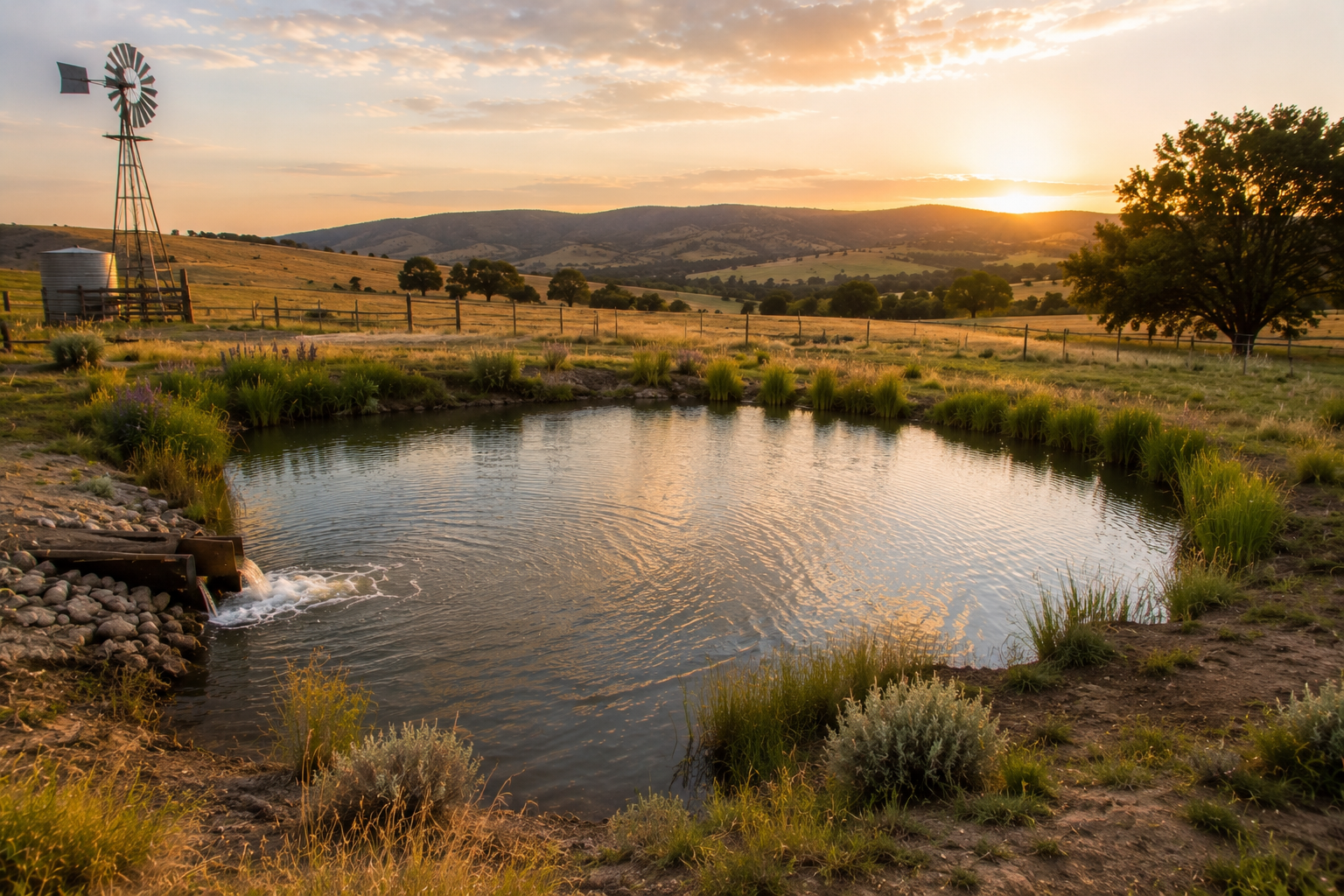
Reliable water storage is one of the most important tools for improving agricultural resilience, especially in regions affected by drought, changing rainfall patterns, and increasing water demands. The guide On-Farm Water Storages: Guidelines for Siting, Design, Construction & Management, developed in New South Wales, Australia, provides a practical overview of the farm pond planning process and offers valuable insights that apply well beyond its original geographic context.
While designed for Australian farming systems, the guide presents universal principles that can help farmers, ranchers, and landowners better understand how on-farm water storage systems support sustainable agriculture, water conservation, and long-term land management.
The publication walks readers through the key stages of developing farm ponds and water storage systems, beginning with proper site selection. Factors such as topography, soil type, runoff patterns, watershed size, and environmental impacts all play an important role in determining whether a location is suitable for pond construction. The guide also discusses engineering considerations, spillway design, erosion prevention, dam stability, sediment management, and maintenance planning.
In addition to water storage for irrigation and livestock, farm ponds can provide significant environmental benefits. Properly managed ponds may help reduce erosion, slow runoff, improve drought resilience, recharge groundwater, and create valuable habitat for birds, amphibians, pollinators, and other wildlife species. Vegetation buffers and thoughtful shoreline management also contribute to healthier ecosystems and improved water quality.
The guide emphasizes that successful water storage systems require long-term planning and ongoing management to maintain functionality, safety, and environmental value. Regular inspections, sediment control, vegetation management, and water quality monitoring all contribute to the long-term success of farm ponds.
As agriculture continues adapting to climate pressures and water resource challenges, practical resources like this provide valuable guidance for building more resilient and sustainable farming operations.