
DWR
Irrigation Management
On this page: Principles | Applications | Benefits | Resources
Growers have long been concerned about water quality, but today water quantity has emerged as a leading consideration in managing irrigation. Today we not only have to focus on reducing contaminants caused by leaching and runoff, but irrigation systems have to be managed so that the amount of applied water closely matches crop water requirements. Poorly managed irrigation systems can cause soil damage, environmental problems, and contribute to low water use efficiency. As California’s population increases and water becomes more scarce, irrigation management practices will have to become ever more precise. A great deal of effort and resources have been dedicated to improving irrigation management in recent decades with great success. Yet there is still room for improvement and evolving practices and technologies continue to emerge. Going forward, data collection and data management will be critical to “real time” water and energy management.
Irrigation Principles & Technology
Soil Moisture Monitoring and Irrigation Scheduling
One of the best actions growers can take is to accurately predict the timing and amount of irrigation water. There are a variety of methods for determining when and how much to water crops. Simply monitoring soil moisture levels to help determine when to irrigate can significantly optimize water and energy use, maximize yields, improve water use efficiency, and greatly reduce soil erosion. There are several effective, low-cost methods for assessing soil moisture. Combining soil moisture monitoring with a method of irrigation scheduling can produce multiple benefits.
In irrigation scheduling, different factors related to a specific crop and context are assessed to determine water requirements. There are various techniques and software programs readily available for growers to utilize developing irrigation schedules. One method of irrigation scheduling relies on actual weather data in conjunction with crop coefficients to estimate crop water demand. Watering based on evapotranspiration (ET) or plant needs should be used as a method for planning a watering budget and soil/plant-based irrigation schedule to determine irrigation events. One issue with irrigation scheduling is that growers may not have surface water available when needed, this is particularly true with drip/micro irrigation systems.This may create an over reliance on groundwater.
Irrigation systems can be controlled manually or be automated. Recent technological developments include the use of sensors and controls to manage irrigation systems. Automated irrigation systems utilize weather station data and/or moisture sensor data to determine when and for how long to water crops. Sensors are placed into the ground to monitor soil moisture and connected to a control system. The control system can use real-time data from the sensor or a combination of inputs to determine irrigation timing and amount. The sensor tells the computer how much moisture there is in the soil, which determines if water is required. Automated systems typically save on labor, yet tend to be associated with higher equipment costs. Though automated irrigation systems with moisture sensors and weather stations are being more widely adopted, their cost-effectiveness largely depends on the experience of the grower, crop, and irrigation method.
Drip and Micro-Irrigation
One of the more efficient forms of irrigation can be micro- or drip irrigation. Drip irrigation employs drip emitters that slowly apply water to crop root zones. Drip irrigation usually consists of a pressurized tubing system that is run along crop rows. These tubes are fitted with emission devices at specific distances to allow water to drip from the emitters.
Micro-irrigation is typically used on tree crops. The two distinct features of micro-irrigation are the need for high irrigation frequency and localized water application to only part of the crop’s potential root zone. These two factors are the framework that make up difference between micro-irrigation and traditional surface (flood) irrigation methods. Research shows that there is a minimum level of available soil moisture required for plants to maintain growth. A well managed micro-irrigation system should maintain a moisture level above the predetermined threshold. Over-irrigation should be avoided, because saturated soils can injure a plant by causing inadequate root aeration promoting root rot and/or loss of nutrients.
Another application of drip irrigation is subsurface drip irrigation (SDI). This is the irrigation of crops through buried plastic tubes containing emitters spaced at repeating distance (e.g. 8, 12, 18 or 24 inches). The tubing and emitters are generally buried 2 to 10 inches (5 to 25 cm) below the soil surface. In the United States, SDI is most widely used for the irrigation of annual row and field crops, but it can be used for permanent crops as well. In other parts of the world, SDI is successfully used for the irrigation of permanent crops. SDI is an efficient irrigation system that greatly reduces evaporation from the soil surface, often resulting in substantial water savings when compared with flood or sprinkler irrigation. As with drip irrigation, sub-surface drip adoption has proceeded slowly due to the high initial cost and intensive management requirements.
DWR
Precision irrigation isn’t just about saving water—it’s about knowing when not to irrigate.
Center Pivot Technology
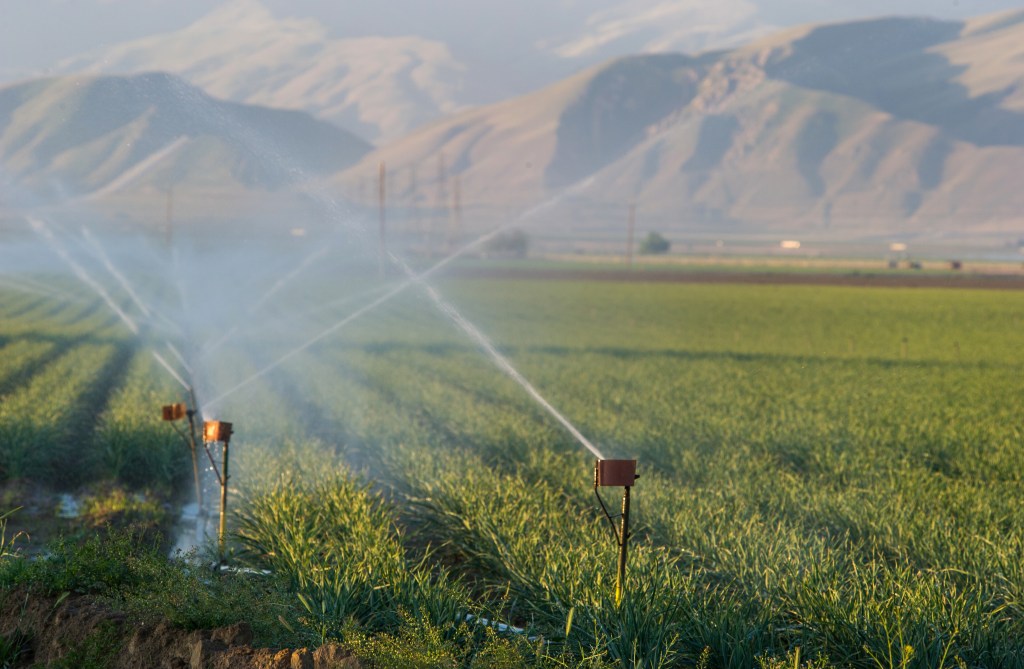
Center pivot technology is typically used on large fields with soils with relatively high infiltration rates. Pivots are commonly used on row crops and vegetables. Sprinkler heads can be lowered to just inches above the tops of the plants, which minimizes water loss from evaporation and wind drift. The technology is both labor and water efficient.
Deficit Irrigation
The aforementioned methods and technologies are but a small example of the applications available for irrigation management. Growers are encouraged to consult irrigation professionals or farm advisors before implementing significant changes in their irrigation practices.
Deficit (or regulated deficit) irrigation is providing less water than the crop wants at specific times of the growing season. When properly done, it can increase water use efficiency by maintaining yields or increasing crop quality (wine grapes) per unit of irrigation water applied. However, deficit irrigation has been shown to work only for certain crops and the grower must have prior knowledge of crop yield responses to deficit irrigation. One of the greatest obstacles to implementing deficit irrigation is that it has only been shown effective for a handful of the wide range of crops grown in California. More research on deficit irrigation for specific crops and irrigation methods is needed to ensure guidelines for implementation are successful.
The aforementioned methods and technologies are but a small example of the applications available for irrigation management. Growers are encouraged to consult irrigation professionals or farm advisors before implementing significant changes in their irrigation practices.
Uniformity vs. Efficiency
An irrigation technology or practice can be measured in many ways. Two of the most commonly used terms when it comes to measuring an irrigation system’s performance are uniformity and efficiency. In irrigation quite often the terms uniformity and efficiency are used interchangeably, but in reality, they each define a different situation. To be more exact, efficiency is the ratio between how much water the plant beneficially uses compared with how much water the irrigation system applies.
Percent efficiency = 100 x water used by the plant / water applied
Uniformity, on the other hand, relates to how evenly you apply water over an area. Equipment selection and the design of the irrigation system affect the uniformity of your irrigation system. Also, system maintenance can be very important.
System design and management are keys to efficient irrigation systems. This means to get optimum performance from your irrigation system, you must properly design, maintain, and manage it. If you don’t optimize all of these variables, system efficiency will be reduced.
The future of farming in California depends on our ability to make every drop count.
Water Savings
With the recent drought and water shortages, managing and conserving water has been a major concern in California. The methods and applications mentioned above are just a few irrigation management practices that are being practiced today. The basis of irrigation scheduling is to determine the amount of water to apply to a field and when to apply it. In drip irrigation, water is slowly but directly applied to the plant root zone. Water is not wasted on non-growth areas and the plant root zone is maintained at its ideal moisture level when properly scheduled. Drip irrigation can maintain an optimum moisture level in the soil at all times with less water lost to the sun and the wind. Drip irrigation can optimize applied water used on crops and orchards.
Subsurface drip further reduces the loss of water due to evaporation and/or wind. Subsurface drip irrigation does not typically wet the soil surface, so weeds do no germinate. Regulated deficit irrigation has been shown to reduce additional water use. Using the above technologies and methodologies in conjunction can increase total water savings.
Applications
Irrigation scheduling is a practice that all growers who irrigate should be practicing. Irrigation scheduling can be done in various ways and with most if not all crops and scales of production.
Drip irrigation is currently being used in trees and vines, particularly in new plantings all over California. With the recent drought and water shortages, more and more farmers are employing drip technology, with total acreage now exceeding flood irrigation in California. Subsurface drip is currently utilized on over 20,000 acres in California, primarily on alfalfa.
There are three measurements important to make sure your irrigation system is applying the right amount of water to the crop. One is weather or ET data, the second is soil moisture levels, and the third is flow information into the field. The information from all three should support good irrigation practices.
Photo by Karolina Grabowska
Additional Benefits
The adoption of irrigation methods that optimize water use is essential to establishing agricultural systems that use available water more efficiently and yet maintain crop production capacity. Changes in irrigation practices will likely require reassessment of fertilizer application rates and delivery practices as well. These changes are key to developing efficient and sustainable cropping systems that will benefit the environment, the grower and consumer. For example, the efficient delivery of water and nutrients to crops will likely lead to less greenhouse gas emissions by reducing available nitrogen and making the soil environment less conducive (less water throughout profile) in producing nitrous oxide, the most potent greenhouse gas. Current agriculture fertilization practices throughout the world contribute significantly to nitrous oxide production. The efficient use of fertilizer and water management will allow growers to enhance and diversify their income sources by enhancing the efficient use of inputs and participating in emerging carbon and greenhouse gas markets.
Research has suggested that many farmers often under-irrigate, some from lack of knowledge and information, while others under-irrigate as a deliberate decision to save water or benefit from the quality of crop. In reality, providing crops with too much water is much more harmful than providing crops with too little. Another important note is that although the initial cost of these systems at the outset are generally high, their relative cost over a life span of 15-40 years is offset by the improved quality, uniformity, and higher production associated with the technology or practices. Secondary benefits include stretched water supply and money saved on energy and water costs.
By increasing the use of every drop of water we are also supporting agricultural jobs. With a large portion of California’s population dependent on these jobs, water is essential to keeping California’s economy flourishing.
Better managing irrigation water may have energy benefits as well, especially if the water source for irrigation is groundwater. By more efficiently managing irrigation, growers should need to pump less groundwater and therefore should be able to reduce energy use.

DWR
Page Credit
Content for this page was originally developed by Kaomine Vang and Dr. David Zoldoske, California State University Water Resources and Policy Initiative and Sarge Green, CSUFresno California Water Institute. Various others have since contributed content.
Featured Irrigation Resources
Frank Leeds: Exploring the History and Practice of Dry Farming in Napa Valley (Video)
Produced by Community Alliance with Family Farmers (CAFF), this video features Frank Leeds who describes the history and practice of his extensive dry farm experience in vineyards.
Dry Farming Vineyards: An Interview with Lauren Leeds Pesch (Podcast)
Dry farming is more than just skipping irrigation—it’s a deliberate practice that starts with soil stewardship. In this podcast, Lauryn Leeds Pesch of Chavez & Leeds Family Vineyards and Leeds & Pesch Vineyard Consulting shares her deep-rooted knowledge in dry farming, a technique that relies solely on stored winter and spring rainfall to meet a…
Can Your Vineyard Soil Hold Enough Water Without Irrigation? (Podcast)
In this podcast, Miguel Garcia, Regenative Agriculture Project Manager at Napa RCD, shares findings from a 15-vineyard study across California’s North Coast. By measuring organic matter, soil respiration, active carbon, and aggregate stability, the project evaluates how soils store and supply water over the growing season.
Return on Investment for Improving DU (Tool)
The online estimator identifies areas of an irrigation system needing maintenance, repairs or upgrades to improve distribution uniformity. It also translates the distribution uniformity score into an estimated financial return on investment based on estimated water, energy and fertilizer savings as well as estimated potential yield improvements.
Exploring the Policy and Practice of Water Reuse in Israel (Video)
This 3-part video series describes implementation, technology, and mechanisms of Israel’s significant water reuse programs in agriculture.
Summary of California’s Water Reuse Guideline or Regulation for Agriculture (EPA)
This page is part of the EPA’s REUSExplorer tool, which summarizes the different state level regulations or guidelines for water reuse for a variety of sources and end-uses. The source water for this summary is Treated Municipal Wastewater.
Something went wrong. Please refresh the page and/or try again.