Photo by: Encyclopedia Britannica
Keyline
Design
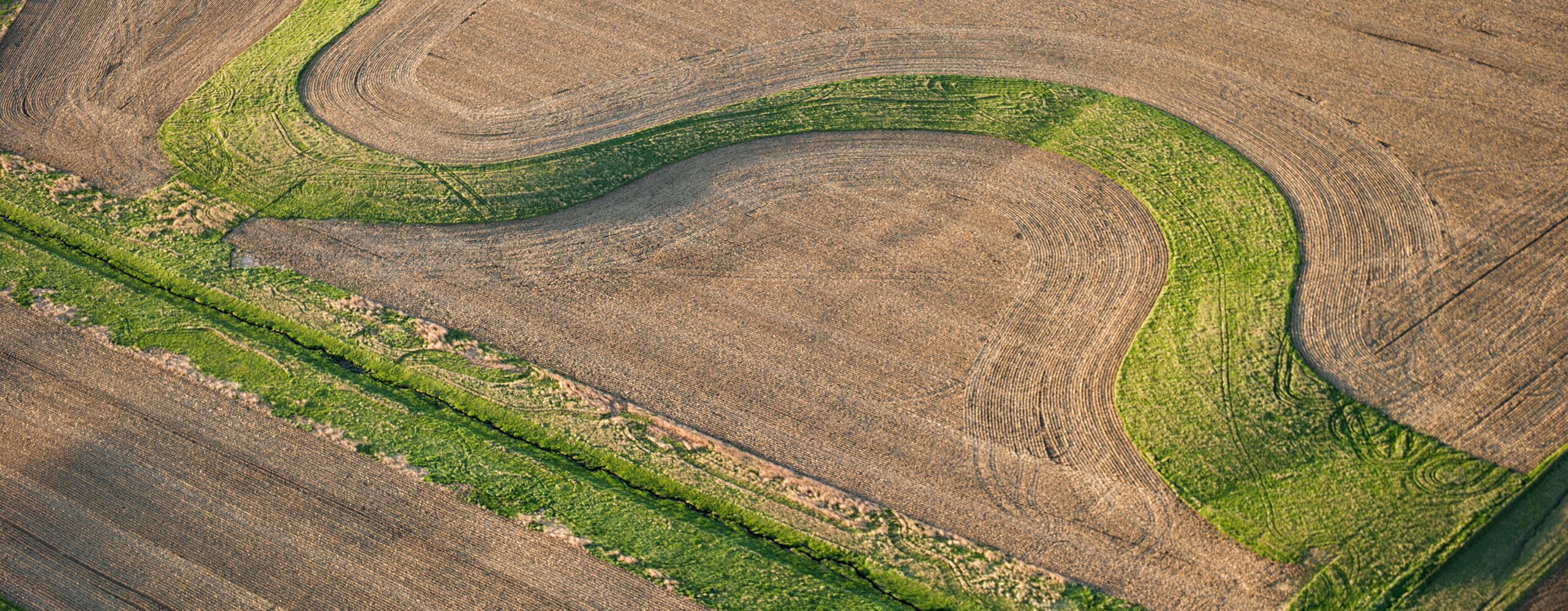
Keyline design was originally developed by P.A. Yeomans in the 1950s to address dwindling water supplies and soil erosion on Australian rangeland. He worked out a system of ‘amplified contour ripping’ that maximizes productive use of rainfall and facilitates the uniform irrigation of land. Keyline is a comprehensive whole farm water management plan that uses natural landscape contours and cultivation techniques to harvest rainwater and build soil fertility. The central idea behind keyline design from a water perspective is to capture water at the highest possible elevation and comb it outward toward the ridges using gravitational forces, reversing the natural concentration of water in valleys. Maximizing the flow of water to the drier ridges using precise plow lines falling slightly off-contour slows the movement of water and spreads it more uniformly, infiltrating it across the broadest possible area.
Keyline design involves a landscape-scale understanding of the relationship of topography and water movement. A keypoint is the point on a slope cross-section where the slope transitions from convex to concave, where the convex ridge characterized by high erosion gives way to the depositional concave slope. Keypoints are often characterized by the beginning of a discernable channel, where subsurface flow from higher in the slope surfaces, in effect like the end of a pipe, and can be effectively captured and redistributed. A keyline is the contour line that intersects with the keypoint. As opposed to contour lines which often vary in distance along their length, keylines fall off contour at the same elevation along the length of the line such that keylines are always parallel to each other, making the creation of keyline cuts particularly amenable to mechanical management using a tractor and plow.

Photo by Jericho Settlers Farm
Keyline design captures rainwater at the highest elevation and redistributes it evenly across the land.
The Yeomans plow, sometimes called a keyline plow or subsoiler plow, is an effective technology for helping realize the keyline concept: it is a special chisel plow that loosens the sub-soil without inverting the soil. The small ridges created by the plow on the soil surface facilitate the movement of water downwards through the soil profile and direct the movement of water across the land. The plow also facilitates the transport of organic matter deeper into the soil horizon.
Keyline plans typically employ water storage (usually ponds) as a component of the overall plan. Small ponds of surplus runoff water can be placed at the natural intersection of a ridge and a valley, or convex and concave slopes, known as a key point. This stored water can provide gravity-fed irrigation later in the season for pastureland or crops. The spillway or primary outlet channel from ponds is managed to maximize the water distribution to irrigate the land below.
Water Savings
By effectively capturing and distributing rainwater and enhancing soils, keyline design allows the grower or rancher to begin to irrigate from off-farm sources later in the season, and may lead to the need for fewer applications in the dry season. Keyline systems capture significant quantities of water that would otherwise run off and store it in the soil. Keyline systems also build soil fertility, which further improves moisture-holding capacity. Ultimately, while no research has quantified the reductions in applied water associated with this system, it is clear that the benefits are substantial. For instance, we know that for each 1% increase in soil organic matter, there is an increase of water storage by 16,000 gallons per acre-foot of applied water.
Applications
Keyline applications in California are new and not currently widely explored. The techniques and principles have been employed extensively in Australia, where keyline was first developed. While keyline systems were originally developed for rangeland and are widely applied in that context, they are increasingly being used in the development of reforestation projects, vineyards, and crop production. Keyline and the use of the Yeomans plow can benefit all agriculture, from upland pasture to low-gradient bottomland. It has been successfully applied to land with a 1-foot rise for a 5,000-foot distance. The Yeomans plow is especially useful on highly compacted soils of any grade, where it substantially increases infiltration and soil fertility, and reduces erosion and runoff.
Additional Benefits
Soil Enhancement and Carbon Sequestration
Along with improved water management, the enhancement of soil fertility is a key goal of keyline. P.A. Yeomans fundamentally believed that “…soil can be improved beyond its best natural or original fertility and the process is simple, rapid and economical.” The Yeomans plow effectively moves organic matter down through the soil horizon. The Marin Carbon Project is one effort in California working to document the potential of the Yeomans plow to sequester carbon in rangeland soils. The plow works by employing sharp blades on the forward face of the tynes to break up compacted soil. Each tine has a foot on its base that combs through the lower layers of the soil, cracking open and aerating the soil, and allowing organic matter to travel downwards.
Erosion and Sediment Control
Keyline systems contribute significantly to erosion control by greatly reducing or eliminating the overland flow that transports topsoil. Keyline systems slow the transport of water, spread it out across a larger area, and sink more of it into the soil, minimizing water erosion and controlling salinity. As a result, the output of sediment-laden water to streams is reduced, which also benefits the aquatic environment in California’s streams and rivers. Keyline also builds healthier soils that are less prone to erosion. The cultivation pattern helps to spread water evenly, stabilizing valleys and further preventing erosion.
Flood Control, Stream Enhancement,
Groundwater Recharge and Watershed Health
By capturing and retaining water, keyline systems help control flooding. The net effect of keyline is to flatten hydrograph peaks, reducing flooding during storm events by storing more water in the soil and in storage, and allowing stored water to seep back into waterways over a much longer period of time. The implementation of keyline plans on multiple farms and ranches in a given watershed can significantly benefit the health of the watershed as a whole, as well as local fisheries and other water-dependent industries such as tourism. Keyline can lengthen the run of seasonal creeks, augmenting supply in drier summer months and improving the quality of water returned from farms to waterways. Keyline can also contribute to groundwater recharge, improving the health of wells and, in particular, increasing water security in alluvial valleys.

Photo by: Encyclopedia Britannica